

Use an Irrigation Component Record to Compare Suppliers
For center-pivot irrigation sourcing, make the component-to-supplier record the unit of review. Identify whether the need is a drop pipe, hose weight, drive shaft tube, or another pipe-and-tube component, then trace that part through its equipment interface, accessory compatibility, geometry, material direction, extrusion controls, evidence, and commercial response. This application record gives each supplier the same context without treating a broad catalog label as proof of fit.
A broad product description can show that a supplier works with pipe, tube, or profiles. A low unit price can show only one part of the commercial picture. Your sourcing decision needs more. You need to know whether the supplier understands the application, can discuss dimensional consistency and tolerances, can respond to custom tubing or profile requirements, and can explain how production volume and accessory compatibility affect the proposal. Those are practical supplier-fit questions, not marketing labels.
Use four gates before you compare quotes:
- Application fit: Can the supplier discuss the service conditions, interfaces, environmental exposure, and operating requirements that matter to your component?
- Process fit: Can the supplier explain the extrusion path, tooling, geometry control, and production assumptions behind the proposed pipe or tube?
- Evidence fit: Can the supplier provide quality information, material documentation, dimensional records, or certification details that match your application?
- Commercial fit: Can you compare tooling, unit price, volume, freight, inventory, tariffs, and communication requirements on the same basis?
This order prevents the quote from becoming the specification. Define what the component must do first, then ask suppliers to respond to the same record. The result is a sourcing conversation that is easier to compare and easier to carry into engineering review.
Create one comparison record before contacting suppliers. Give each gate a place for the supplier’s answer, supporting document, open question, and responsible follow-up. That structure keeps a missing answer visible instead of allowing a familiar product label or attractive price to fill the gap.
Classify the component and its extrusion path
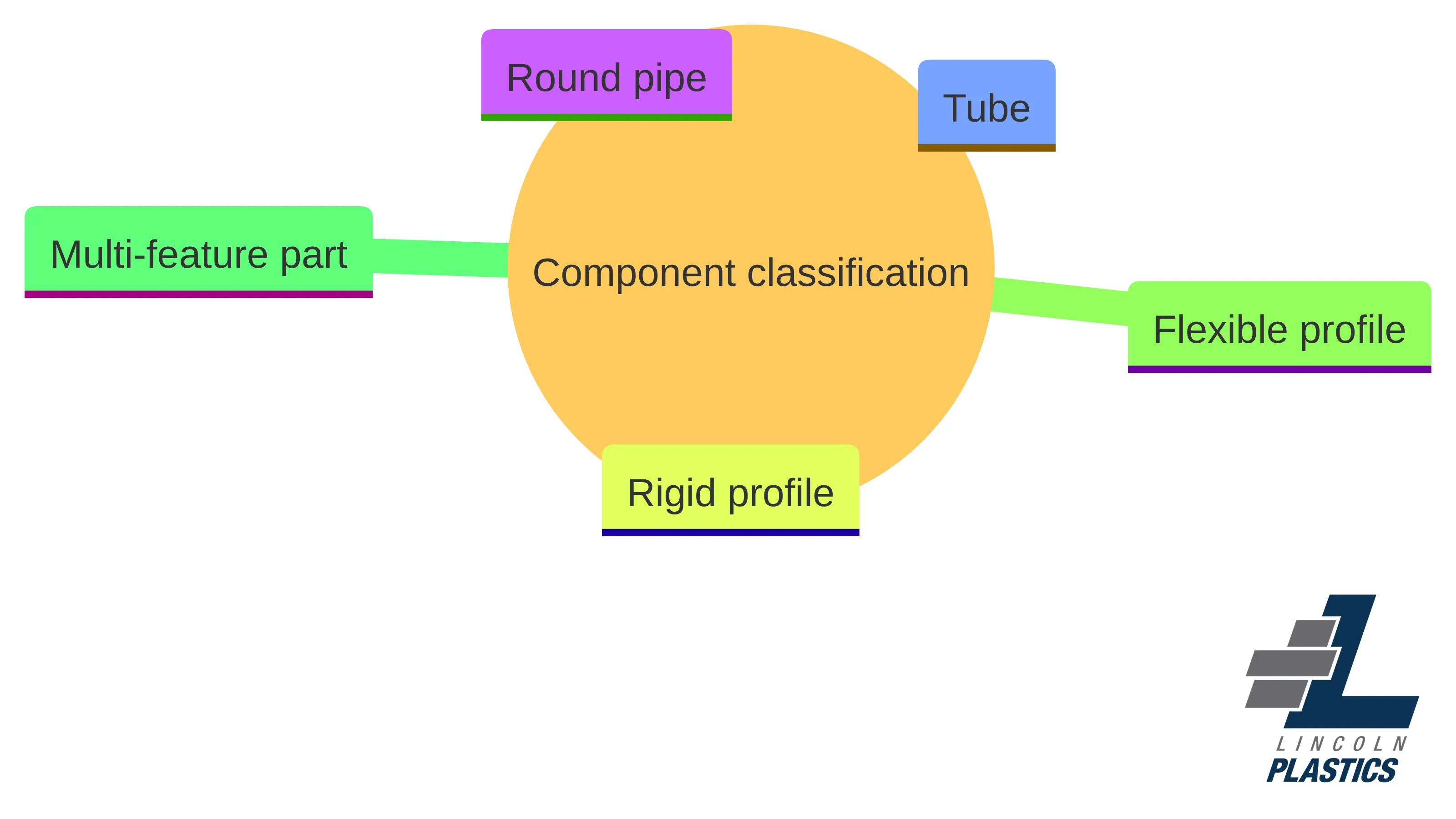
Your component category determines the questions you need to ask about extrusion. A round irrigation pipe, a small OEM tube, a flexible profile, and a custom-shaped profile may all be extruded, but they do not present the same geometry, interface, or sourcing discussion.
Start by describing the part in functional terms:
- Round pipe: State whether the part carries, guides, protects, or surrounds a fluid or another component.
- Tube: State whether the tube connects to fittings, slides over another part, guides a cable, or forms part of an assembly.
- Rigid profile: Describe the cross-section, mounting features, channels, lips, or other interfaces that must remain consistent.
- Flexible profile: Describe the movement, bending, compression, or covering requirement that makes flexibility relevant.
- Multi-feature part: Identify every feature that affects assembly, rather than describing the item only by its outside shape.
Extrusion applications can include water-supply pipes, dip tubes, air tubing, industrial hoses, and custom profiles made from materials such as PP, PE, ABS, TPU, and PVC. That range shows why the word tube is not enough to define a sourcing request. Your description should identify the product form, intended use, material direction, dimensions, supply length, and connection requirements.
The extrusion die shapes molten polymer into the product form. Die design influences circular shape, wall-thickness uniformity, material flow, and surface quality. Ask the supplier which features of your cross-section depend on the proposed tooling and which dimensions will be measured during production.
A custom shape also creates a tooling question. Ask whether new tooling is needed, whether existing tooling could be adapted, who owns the tooling, and whether the supplier operates the extrusion line or resells parts made elsewhere. Keep those answers with the component classification so you can distinguish a manufacturing proposal from a distribution proposal.
Record the supply form separately from the shape. Straight lengths, cut pieces, coils, or another form can change packaging, handling, inspection, and commercial assumptions. Ask the supplier to identify the proposed form and any consequence it has for your assembly or order pattern. The classification is complete when another supplier could understand what the part is, what it must connect to, and how you expect to receive it.
Define the service the component must perform
The component’s service conditions should guide the supplier conversation before you discuss a resin name or a target price. Describe what the pipe or tube must do in the equipment, where it will operate, and what conditions can affect its use.
Your service description should answer these questions:
- Does the component carry water, guide water, protect another part, or provide a structural or assembly interface?
- Does the component experience internal pressure, external loading, vibration, bending, compression, or repeated movement?
- Will the component be exposed to sunlight, weather, moisture, temperature changes, agricultural chemicals, cleaning agents, oils, or other substances?
- Does the part need to remain flexible, rigid, dimensionally stable, or compatible with a particular fitting or accessory?
- What operating temperature range, service duration, and seasonal conditions should the supplier consider?
- Which surfaces, dimensions, or interfaces affect installation and continued operation?
Treat UV exposure as a defined requirement rather than an assumption. Record whether the part will remain outdoors, how long exposure matters to the application, and what evidence you expect for the selected material or formulation. A color, a generic polymer name, or the word outdoor does not by itself define the requirement. Ask how the supplier and resin source will address the application conditions you have documented.
Agricultural extrusion suppliers may offer custom tubing, profiles, and extrusion products made from HDPE, polyethylene, polypropylene, and PVC. That information can help you identify material categories for discussion, but it does not select a material for your equipment. The material decision still has to connect the service conditions, interfaces, environmental exposure, and required behavior.
Give suppliers the same service description. A supplier that asks about the operating environment and accessory compatibility is addressing the application rather than quoting a generic tube. Keep the answers in your requirement record so you can compare how each proposal responds to the same conditions.
Separate known conditions from assumptions. Mark the temperature range, exposure, fluid contact, loading, and movement requirements that are confirmed by your equipment documentation, then list the items that still require an engineering decision. This gives the supplier a usable brief without turning an unconfirmed operating detail into a fixed specification.
Lock down geometry before discussing price
Your geometry record should make wall thickness, sizing, interfaces, and tolerances visible before a supplier prepares a price. A general description such as standard irrigation pipe or custom OEM tubing leaves too many manufacturing questions open.
Include these items in the drawing or technical attachment:
- Outside diameter, inside diameter, and wall thickness where those dimensions apply.
- Nominal dimensions and the permissible tolerance for each feature that affects fit, flow, sealing, assembly, or clearance.
- Finished length, cut-length tolerance, coil or straight-length requirements, and any end treatment required for the supplied form.
- Connection features such as threads, grooves, sockets, flanges, holes, lips, or fitting interfaces.
- Cross-section details that affect bending, insertion, retention, routing, or contact with another component.
- Surface, color, marking, or identification requirements that matter to assembly or field handling.
- A clear indication of which dimensions are critical and which dimensions can use a wider production range.
The supplier needs the drawing, but you also need an explanation of the production consequences. In pipe extrusion, the die influences circular shape and wall-thickness uniformity. Ask how the proposed process will address the features that matter most to your assembly, and ask which dimensions will appear on the inspection record.
Avoid specifying extremely tight tolerances simply to make the drawing look precise. Extremely tight extrusion tolerances can increase custom-extrusion costs, so define critical areas and required limits according to the intended use. A tolerance should answer a fit or function question. If a dimension does not affect installation, sealing, clearance, or another defined requirement, identify that fact rather than assigning an unnecessarily narrow range.
Ask each supplier to return comments against the same drawing. A useful response identifies manufacturability concerns, tooling implications, tolerance questions, and any dimension that requires clarification. That response gives you more information than a unit price alone.
Mark the dimensions that require inspection at incoming receipt, during assembly, or during another defined review. Then ask the supplier to identify which of those dimensions can be measured during production and which require a separate sample or inspection step. This does not set acceptance limits for your equipment; it makes the inspection conversation concrete before the quote is accepted.
Keep material selection tied to the application
Material selection should follow the service description, not precede it. Your specification should identify a target polymer or a material category when you have an established requirement, while leaving room for a resin supplier or qualified material specialist to recommend a suitable grade for the documented conditions.
Build the material discussion around the part’s actual use:
- Name the target polymer, grade, or approved material family when your design already establishes it.
- Describe the outdoor exposure, UV requirement, temperature range, fluid contact, chemical contact, and mechanical conditions that the material must address.
- State whether flexibility, rigidity, impact behavior, surface finish, color, or dimensional stability affects the assembly.
- Identify any material documentation, lot traceability, or certification requirement that applies to the market and use.
- Separate a required material property from a preferred formulation feature so the supplier can respond clearly.
Agricultural extrusion offerings may include HDPE, polyethylene, polypropylene, and PVC. Those materials appear in agricultural tubing and profile work, but a supplier’s ability to process a material does not establish that the material is suitable for your component. Ask the supplier to respond to the application conditions and identify any material assumptions in the quote.
Keep manufacturing guidance separate from material authority. Lincoln Plastics can discuss extrusion manufacturability, geometry, tolerances, and production considerations, while the material direction should remain tied to your application requirements and the recommendation of the appropriate resin source. That separation keeps the supplier from turning a convenient available material into an unexamined design decision.
Record the proposed material, grade, additives or formulation requirements, documentation, and unresolved questions in one place. If two suppliers quote different material directions, compare those proposals against the same service conditions rather than comparing resin names in isolation.
Ask for the material information needed for your own review, such as the proposed grade, formulation assumptions, applicable documentation, and the conditions the supplier used when making its recommendation. Keep a proposed material separate from an approved material. That distinction lets the supplier contribute manufacturing guidance without transferring the application decision away from the party responsible for the equipment.
Ask how the supplier will control the tube or pipe
Supplier process questions should connect the drawing to the production method. You do not need a long equipment description; you need enough detail to understand how the supplier will address your critical geometry, material direction, volume, and inspection requirements.
Ask the supplier to explain:
- The proposed extrusion path. Ask how the material will move through the proposed tooling and how the die relates to the round shape, wall thickness, cross-section, or surface requirements in your drawing.
- Tooling responsibility. Ask whether the supplier owns the tooling, operates its own extrusion lines, or uses another shop for the extruded parts. Ask who controls design changes and maintenance.
- Dimensional control. Ask which dimensions will be measured, how often they will be checked, what equipment or method will be used, and how the results will be recorded.
- Tolerance response. Ask which tolerances the supplier accepts as written, which require discussion, and which features may affect tooling cost or production yield.
- Production assumptions. Ask how annual volume, order pattern, finished length, packaging, and requested delivery schedule affect the proposal.
- Accessory compatibility. Ask how the supplier will address fittings, covers, weights, connectors, or other components that must work with the tubing or pipe.
The die shapes the molten polymer, and its design influences circular shape, wall-thickness uniformity, material flow, and surface quality. That makes tooling discussion part of product definition rather than a separate purchasing detail.
A tubing supplier should understand the application, discuss material recommendations, maintain dimensional consistency, communicate about lead times and tolerances, and support custom tubing, production volumes, and accessory compatibility. Turn each point into a question in your supplier comparison record. A clear answer does not approve the component, but it shows whether the supplier is addressing the same requirements you documented.
Ask the supplier to distinguish a design assumption from a production control. For example, a proposed die may address the cross-section, while a measurement plan addresses how the finished dimension will be checked. Keeping those answers separate helps you identify whether an open issue concerns tooling, process monitoring, inspection, or application approval.
Request the same process response from every candidate. Consistent questions make it easier to see whether two suppliers are discussing the same geometry and supply conditions or are quoting different interpretations of your request.
Separate supplier evidence from application approval
Supplier qualification and application approval are separate decisions. A supplier can explain its extrusion process, provide dimensional information, and show quality controls without establishing that a particular pipe or tube meets every operating requirement in your equipment.
Use two records instead of one. The supplier evidence record should contain process answers, tooling ownership, production location, dimensional-control information, material documentation, certification details, samples, and commercial assumptions. The application approval record should contain the engineering requirements, service conditions, fit checks, interface review, test criteria, and the decision to release the component for use.
This separation helps you ask a precise follow-up question. If the supplier cannot answer a process question, the issue is supplier qualification. If the supplier answers the process question but the material or geometry has not been evaluated against your equipment, the issue remains application approval. Do not treat one answer as proof of the other.
Samples can support the evaluation before a substantial order. Request samples before a substantial order to evaluate their quality and performance against your specifications. A sample is useful only when you define what you will inspect and what result would require a design or process discussion.
Certification requirements also belong in the application record. Check them against the specific use and market rather than treating a general certification as a substitute for every requirement. ISO 9001, FDA or USP Class VI, UL 94, REACH, and RoHS can relate to different applications or markets; identify which requirement applies to your component before asking a supplier to provide supporting information.
The practical boundary is simple: supplier evidence supports a sourcing decision, while your completed engineering review determines whether the proposed component can move forward.
Give each record an owner and a status for every open item. A supplier can provide a document, answer a question, or identify a limitation; your organization still needs to decide whether that information satisfies the application requirement. This prevents a certificate, sample, or process explanation from being treated as an automatic release decision.
Build the inquiry around a complete technical packet
Your RFQ should give the supplier enough information to review the component before preparing a proposal. A complete packet reduces avoidable clarification cycles and makes responses easier to compare.
Include these core items:
- Drawing or model: Attach the current drawing, cross-section, dimensional callouts, interfaces, and revision information.
- Tolerances: Identify the required limits and mark the dimensions that affect fit, function, sealing, flow, clearance, or assembly.
- Target polymer: Name the target polymer or approved material direction, and identify where you need a material recommendation tied to the service conditions.
- Annual volume: State expected annual demand, anticipated order pattern, and any meaningful change in volume over the planning period.
- Applicable certifications: List the certifications, declarations, material documents, or market requirements that apply to the specific product.
A complete RFQ should also carry the service description from the earlier sections. Explain whether the component carries or guides water, connects to another part, remains outdoors, experiences movement or loading, or must work with a defined accessory. Provide the environmental and operating conditions that affect material and geometry decisions.
Ask the supplier to return a marked-up response that identifies assumptions, tooling needs, dimensional concerns, material questions, and unresolved requirements. Request the proposed supply form, such as cut lengths or another defined form, only when your application requires that distinction. Keep the same packet for every supplier so the commercial comparison does not hide technical differences.
A supplier that cannot quote from the packet may still be useful, but the next step is clarification rather than a direct price comparison. Record what information is missing, who must provide it, and whether the missing item changes the component design, material direction, tooling, or commercial model.
Add a short response schedule to the packet. Ask each supplier to identify the proposed material, tooling status, dimensional-control approach, quality documents, commercial assumptions, and questions requiring your answer. This gives you a consistent response format without forcing suppliers to make unsupported assumptions about the design.
Before sending the inquiry, check that the drawing revision, annual volume, supply form, and certification list agree with the body of the RFQ. Internal inconsistencies can produce different quotes for what appears to be the same part.
Make tooling and volume economics explicit
Tooling and volume assumptions can change the economics of a custom pipe or tube, so make both visible before you compare proposals. A quote that shows only a unit price leaves out the assumptions that may drive the actual sourcing decision.
Ask each supplier to separate:
- Tooling design and fabrication costs.
- Tooling ownership, storage, maintenance, and change responsibility.
- Any tooling cost amortization across projected order quantities.
- Unit price by volume level and the assumptions behind each level.
- Material pricing assumptions and any minimum production condition stated in the proposal.
- Freight, tariffs, inventory, and communication overhead when comparing domestic and overseas options.
- The effect of finished length, packaging, shipment frequency, and order pattern on the commercial response.
Ask how custom-profile tooling is priced and how the cost is spread across projected order quantities. That question lets you model the per-part effect of a one-time tooling charge without assuming that every supplier uses the same approach.
Compare total cost of ownership rather than unit price alone. Total cost can include unit price, freight, tariffs, inventory, and communication overhead. A domestic and an overseas proposal may carry different cost categories, so place those categories in the same comparison record instead of treating the quoted part price as the complete answer.
Geometry also belongs in the economics discussion. Extremely tight extrusion tolerances can increase custom-extrusion costs. If your drawing includes narrow limits, ask the supplier to identify which features create the cost impact and whether a wider tolerance would still meet the defined use. Do not widen a tolerance simply to reduce price; connect any change to fit and function.
Use the same annual volume and demand pattern for every response. If a supplier makes a different assumption, record it beside the price rather than blending unlike proposals into one average.
Separate one-time, recurring, and variable costs in your worksheet. A tooling charge, a per-unit price, a shipment cost, and an inventory assumption answer different commercial questions. Keeping them in separate fields makes it easier to revisit the comparison if the annual volume or order pattern changes.
Ask suppliers to state the volume level attached to every price. A price without its quantity, supply form, material assumption, or tooling treatment is not a comparable commercial response.
Use irrigation experience as a relevance check
Irrigation experience is useful when it helps you test application relevance, not when it replaces a technical review. Ask what types of agricultural tubing, profiles, or OEM components the supplier has produced and which parts of that experience relate to your geometry, environment, material direction, and supply form.
Use these questions to make the experience discussion specific:
- Has the supplier produced tubing or pipe for agricultural equipment, irrigation, or another application with comparable outdoor conditions?
- Has the supplier worked from customer drawings or developed a custom profile around an OEM interface?
- Can the supplier discuss the dimensional features that affect fittings, connections, covers, weights, routing, or assembly?
- Can the supplier explain how the proposed material and tooling relate to your service description?
- Can the supplier provide relevant sample, inspection, material, or certification information for the proposed component?
- Does the supplier understand your annual volume, order pattern, and required supply form?
Agricultural extrusion suppliers may offer custom tubing, profiles, and extrusion products using HDPE, polyethylene, polypropylene, and PVC. That establishes a useful category for supplier screening, but it does not prove that a particular design, grade, wall thickness, or UV requirement will fit your equipment.
We provide custom plastic extrusion tubing for OEMs, including applications in irrigation and cord covers. That makes irrigation-related tubing a relevant subject for an initial supplier conversation with us. Your requirement record still needs to establish the exact component, material direction, dimensions, tolerances, quality evidence, and commercial assumptions.
Treat experience as a relevance check. Ask what the supplier can connect to your documented requirement, then keep the resulting answers with the RFQ and application records.
A relevant example should answer a question about your project. If the supplier describes an agricultural part, ask which characteristics are comparable: component form, outdoor exposure, interfaces, material direction, inspection needs, or supply pattern. Do not treat an industry label alone as evidence that the proposed component fits your equipment.
Review Lincoln Plastics against the completed requirement record
Evaluate Lincoln Plastics against your completed requirement record rather than against a general product category. We provide tailored OEM solutions that include pipes, tubes, and flexible profiles. We also provide custom plastic extrusion tubing for OEMs, including applications in irrigation and cord covers.
Our stated scope is relevant when your sourcing task involves a custom or standard extruded pipe, tube, or flexible profile and you need a manufacturing discussion around the stated design. We customize plastic extrusion solutions to fit the unique needs of OEMs, design pipes, profiles, and components to meet clients’ stated needs, and help OEMs fine-tune extrusion designs for manufacturing while maintaining quality standards.
Use your record to frame the initial discussion with Lincoln Plastics:
- Attach the drawing or model and identify the critical dimensions.
- State the target polymer or the material question that needs a qualified recommendation.
- Describe irrigation or OEM service conditions, including outdoor exposure and the UV requirement where applicable.
- Identify the required wall thickness, diameter, length, interfaces, tolerances, and supply form.
- State annual volume, order pattern, certification requirements, and the quality records you need.
- Ask for the proposed extrusion path, tooling assumptions, dimensional-control response, and commercial structure.
This approach keeps our relevant offerings connected to the part you need. It also prevents a general statement about pipes, tubes, or irrigation-related tubing from being treated as an automatic match for every design.
If your record calls for a pipe, tube, or flexible profile within that scope, include Lincoln Plastics in the supplier conversation and ask us to respond to the same technical packet you send to other candidates. Compare the response against the defined requirements, not against an unqualified product label.
Use the same decision record for our response and for every other supplier response. The useful question is whether the proposed manufacturing discussion addresses your documented dimensions, material direction, service conditions, tooling questions, quality evidence, and commercial assumptions. A relevant offering identifies a conversation to pursue; it does not replace the requirement review.
Treat quality claims as questions to verify
Quality claims become useful when they identify the records and controls behind the proposed component. Ask what the supplier’s quality system covers, which dimensions are checked, how results are documented, and how a requirement moves from the drawing into production review.
We are certified to the ISO 9001 standard. We maintain management plans that include dedicated manuals and in-process checks. Those facts are part of our supplier-quality discussion, but they should be connected to your component requirements rather than treated as a substitute for application-specific review.
Ask every supplier for a response to the same quality questions:
- Which drawing revision and specifications govern production?
- Which dimensions, wall-thickness features, surfaces, and interfaces are checked?
- When are checks performed during production, and what records are retained?
- How are material identity and applicable documentation connected to the production lot?
- How are nonconforming parts identified, contained, and communicated?
- Which certification or declaration applies to your market and application?
- What sample, inspection, or approval information accompanies the first production discussion?
Certification requirements should be checked against the specific application. The relevant requirement may involve ISO 9001, FDA or USP Class VI, UL 94, REACH, RoHS, or another documented condition depending on the use and market. Ask the supplier to identify which requirement its response addresses and which application-specific information remains with your organization.
Quality evidence should answer two questions separately: can the supplier describe a controlled manufacturing process, and does the proposed component meet your defined acceptance criteria? Keep both answers in the supplier comparison record.
Ask for the document or record that supports each material quality statement. Then connect that document to the drawing revision, proposed material, inspection point, or market requirement it addresses. This creates a traceable question-and-answer record without treating a general quality statement as proof of every product-specific result.
Know what an early supplier response cannot establish
An early supplier response can clarify manufacturing fit and commercial assumptions, but it does not by itself settle every application question. Treat the first response as a structured decision input that identifies what is established, what requires evidence, and what remains for engineering review.
A quote or introductory capability response should not be treated as proof of:
- Material suitability for your documented temperature, fluid, chemical, weather, or UV conditions.
- Dimensional acceptance across the entire production run.
- Wall-thickness performance in the specific pipe or tube design.
- Compatibility with every fitting, accessory, cover, weight, or mating component.
- Compliance with a certification or market requirement that you have not identified and matched to the application.
- A delivery schedule, price, or volume assumption that the supplier has not stated in the proposal.
- Production results for a design that has not yet been reviewed, tooled, sampled, or measured.
A supplier should communicate about lead times and tolerances, support custom tubing and production volumes, and address accessory compatibility. Those answers help you identify open questions. They do not eliminate the need to define acceptance criteria and compare the proposed material, geometry, tooling, quality evidence, and commercial terms with your requirement record.
Keep uncertainty visible in the comparison. Mark each item as answered, supported by documentation, awaiting clarification, or requiring application evaluation. This simple status record prevents an attractive quote from appearing more complete than it is.
If the early response changes the drawing, material direction, tolerance, or service assumption, revise the RFQ record before comparing prices. A supplier decision is ready for the next stage only when the remaining questions are known and assigned to the party responsible for resolving them.
The early response can therefore establish a next action rather than a final approval. You may need a revised drawing, a material review, a tooling discussion, a sample, an inspection plan, or a commercial clarification. Record that action beside the open question so the sourcing process moves forward without disguising uncertainty.
Use the irrigation component record to choose the next sourcing action
Use an Irrigation Component Record as a center-pivot fit scorecard. Instead of comparing broad supplier descriptions, compare each response against the component's interfaces, outdoor exposure, and available extrusion evidence.
Start by naming the component and its mating role. For a center-pivot request, the record can identify a drop pipe, hose weight, drive shaft tube, or another pipe-and-tube component, then note the accessories or adjacent parts that must fit. This keeps the supplier discussion tied to the component's interchangeability needs rather than to a generic product list.
Record the service and geometry questions next: dimensions, wall thickness, tolerances, target polymer or unresolved material question, annual volume, service conditions, and whether outdoor exposure or UV resistance matters. Treat material selection as customer-specified or as a question for the resin supplier. Ask the extrusion supplier how the requested material and geometry affect manufacturability, tolerances, co-extrusion options, and production considerations.
Use the record to test supplier fit by risk. Ask whether the supplier owns its tooling and runs its own extrusion lines, how custom-profile tooling is priced and spread across projected quantities, and how dimensional consistency is controlled. Also ask what material documentation, certification information, quality evidence, accessory-compatibility support, production-volume support, and irrigation-related experience apply to the component. Check certifications against the application rather than treating a general certification as application approval.
Keep commercial comparison separate from fit review. Compare unit price with freight, tariffs, inventory, communication overhead, and volume assumptions. A lower quoted unit price does not answer whether the geometry, environment, accessory interfaces, or quality evidence match the irrigation requirement.
We provide tailored OEM solutions that include pipes, tubes, and flexible profiles, along with custom plastic extrusion tubing for OEMs, including applications in irrigation and cord covers. We are certified to the ISO 9001 standard and maintain management plans that include dedicated manuals and in-process checks. These offerings may be relevant to the supplier conversation; they do not by themselves establish suitability for a particular machine or operating condition.
Use the completed record to choose the next action: advance to an RFQ or supplier discussion when the response addresses the component's interfaces, geometry, exposure, extrusion controls, quality evidence, and commercial assumptions. Keep any unresolved material, dimensional, certification, or performance question explicit for the next review.


