
Master Polymer Charts: A Step-by-Step Guide for Material Selection
Introduction
Choosing the right material for extrusion projects is crucial, yet it often presents significant challenges. Polymer charts are invaluable tools in this process, offering a visual representation of various materials and their properties, such as tensile strength and thermal stability. Have you ever wondered how to navigate these charts effectively for informed decisions? In this guide, we’ll explore polymer charts and provide step-by-step insights into selecting materials, emphasizing the need for expert guidance and quality management practices like those at Lincoln Plastics.
Understand Polymer Charts and Their Importance
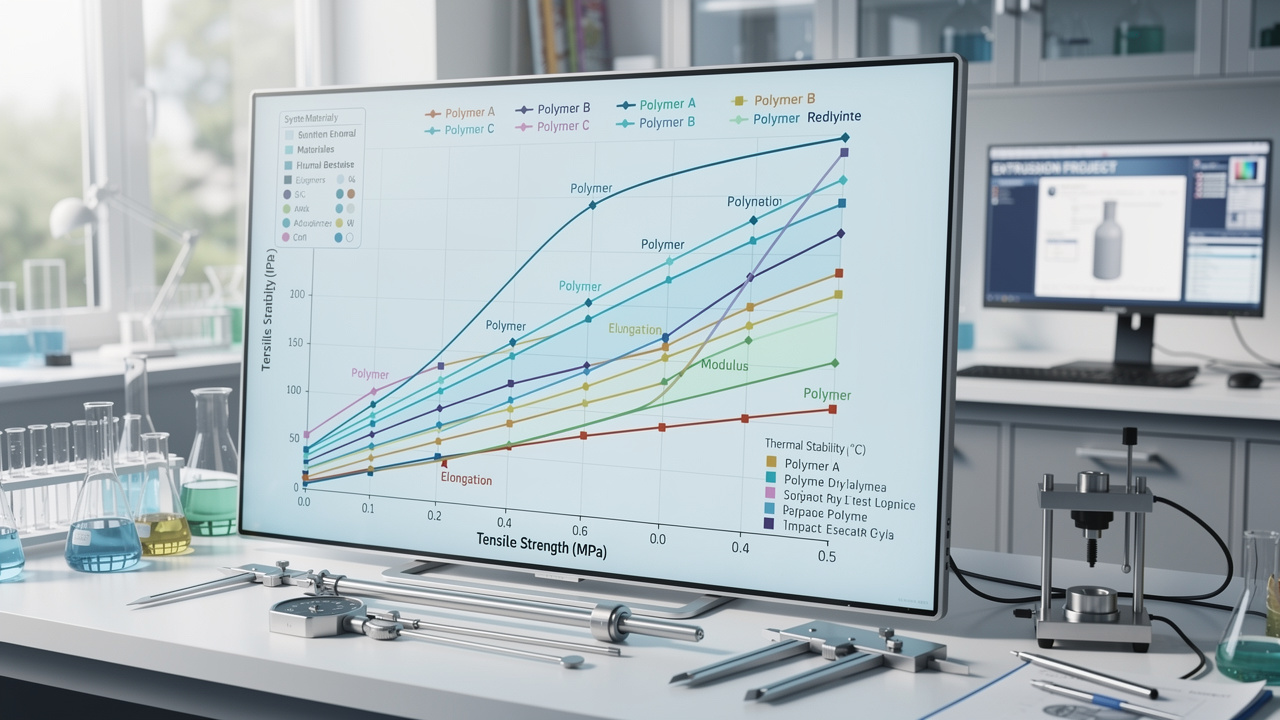
Selecting the right synthetic material is crucial for the success of your extrusion project, yet many face challenges in making informed choices. The polymer chart serves as a visual representation for synthetic materials, illustrating the characteristics of different substances, such as tensile strength, thermal stability, and chemical resistance. Have you ever wondered how to choose the right material for your extrusion project? Understanding the polymer chart is essential. Here’s how to interpret them:
- Identify the Axes: Most material charts have axes that represent different properties. For example, one axis may show tensile strength while the other displays elongation at break.
- Locate your material by finding the polymer you are considering on the polymer chart. This will assist you in visualizing its performance compared to other substances.
- Analyze the Data: Look for clusters of substances that meet your specific requirements. For example, if you require a substance with high tensile strength and low thermal expansion, identify those that fall within that range.
- Consider Trade-offs: What trade-offs are you willing to make when selecting a substance? Recognize that choosing a substance often entails trade-offs. A substance with high strength may possess lower flexibility, so consider the specific needs of your application.
- Seek Guidance from Specialists: If you’re uncertain about how to interpret the data, seek advice from specialists who can offer insights based on their experience and understanding of substance characteristics. Failing to interpret these charts correctly could lead to suboptimal material choices, impacting your project's success.

Identify Common Polymers in Material Selection
Selecting the right materials for extrusion is crucial for achieving optimal performance and reliability in your projects. Knowledge of the most prevalent plastics in the industry is essential. Here are key polymers to consider:
- Polyethylene (PE): Renowned for its flexibility and chemical resistance, PE is extensively used in tubing and packaging applications. Its durability and moisture resistance make it ideal for various products.
- Polyvinyl Chloride (PVC): A versatile substance, PVC offers excellent chemical resistance and is widely utilized in construction materials, pipes, and electrical conduits. Its rigidity is advantageous for structural applications, although it can be susceptible to certain solvents.
- Polypropylene (PP): Known for its toughness and fatigue resistance, PP is suitable for automotive components and industrial applications. Its lower density in relation to other materials can offer design benefits, making it a popular option in various sectors.
- Acrylonitrile Butadiene Styrene (ABS): Valued for its impact resistance and toughness, ABS is commonly used in consumer products and automotive parts. Its ease of molding and availability in various colors enhance its appeal in diverse applications.
- Polystyrene (PS): Lightweight and easy to process, PS is frequently used for packaging and disposable cutlery. However, it has lower impact resistance compared to other materials, which may restrict its use in more demanding applications.
- Thermoplastic Elastomers (TPE): Combining the properties of rubber and plastic, TPEs offer flexibility and durability, making them ideal for applications requiring a soft touch or grip.
Choosing the right material can be daunting, especially with so many options available. At Lincoln Plastics, we’re committed to meeting your specifications for critical dimensions, backed by our ISO 9001:2015 certification and a robust quality management program. This includes comprehensive quality plans, critical in-process checks, and run documentation to guarantee the highest standards. Additionally, we can source colors that meet your Pantone specifications, ensuring consistency across manufacturers. Understanding these materials not only empowers your decision-making but also elevates the quality of your final products. We invite you to contact Lincoln Plastics experts for tailored solutions and to discuss how we can meet additional regulatory requirements beyond ISO 9001.

Apply Polymer Chart Data to Your Material Choices
Understanding the right materials is crucial for the success of your custom plastic extrusion project. Here’s how to make informed choices:
- Define Your Requirements: Start by detailing the specific needs of your project, including mechanical characteristics, environmental conditions, and any regulatory standards. What are the specific mechanical characteristics your project requires? Understanding the tensile strength and thermal stability needed for your application is essential.
- Consult the polymer chart to refer back and identify substances that meet your defined requirements. Look for polymers that fall within the desired ranges for properties such as tensile strength and thermal stability. Case studies have shown that early cooperation with extrusion specialists can significantly enhance the final product's performance by aligning substance selections with project needs.
- Evaluate Performance: Think about how each material will hold up in your specific application. If your product will be exposed to high temperatures, prioritize materials with high thermal resistance. Materials with high thermal stability perform better and last longer in extruded components.
- Consider Processing Characteristics: Evaluate how each polymer performs during the shaping process. Certain substances may require specific processing conditions, such as temperature or pressure adjustments, which can affect production efficiency. For instance, maintaining optimal pressure during extrusion ensures uniform flow and structure, reducing the risk of defects.
- Prototype and Test: Before finalizing your material choice, create prototypes using the selected polymers. Conduct tests to evaluate their performance in real-world conditions, ensuring they meet your project’s requirements. Statistical analysis of mechanical properties can reveal significant enhancements, as seen in studies where specific parameter settings led to increases in strength and toughness.
- Seek Expert Guidance: Navigating the selection process can be daunting without expert guidance. If you encounter challenges or uncertainties, consult with extrusion experts who can provide insights and recommendations based on their experience with similar projects. This collaboration can turn your project from uncertain to successful.

Troubleshoot Common Issues in Material Selection
Selecting the right materials for your project can be a daunting task, filled with potential pitfalls that can derail your progress. Even with a solid understanding of plastic charts and substance properties, challenges can arise during the selection process. Here are some common issues and how to troubleshoot them:
-
Substance Incompatibility: Have you ever faced challenges with material compatibility? Chosen substances may not function as anticipated due to compatibility problems with other elements. For example, specific materials may not bond effectively, leading to structural weaknesses.
- Solution: Refer to compatibility charts and consider utilizing adhesives or coatings to improve bonding between various substances. This approach can significantly enhance the integrity of the final product.
-
Performance Failures: If a substance does not meet performance expectations, you should refer to the polymer chart again to ensure it aligns with your project's requirements. Performance failures can manifest as brittleness or inadequate strength under stress.
- Solution: Re-evaluate your selections and consider alternatives that better match the necessary properties. Interacting with suppliers who focus on compatibility of resources can offer valuable insights.
-
Processing Challenges: You might encounter difficulties during shaping, like blockages or inconsistent output, due to the substance’s processing traits. For example, excessive shear from high screw speeds can lead to melt degradation.
- Solution: Adjust processing parameters, such as temperature and pressure, or consult with extrusion experts to optimize the setup for the chosen substance. Regular monitoring of processing conditions can help identify and rectify issues early.
-
Cost Constraints: The optimal substance may surpass budget limitations, requiring a balance between performance and expense. Selecting low-cost additives without considering compatibility can lead to failures in mechanical testing.
- Solution: Investigate alternative substances that provide comparable characteristics at a reduced price, or consider modifying your design to incorporate more economical choices. Conducting stepwise trials for dosage optimization can also help avoid negative impacts on performance.
-
Regulatory Compliance: Ensuring that chosen substances adhere to industry regulations and standards is critical. Non-compliance can lead to costly delays and product recalls, particularly in sensitive applications like food packaging and medical devices.
- Solution: Stay informed about relevant regulations and consult with compliance experts to ensure your material choices meet all necessary requirements. Requesting essential documents such as Technical Data Sheets (TDS) and Safety Data Sheets (SDS) can help mitigate compliance risks.
By proactively addressing these challenges, you can safeguard your project’s success and ensure compliance with industry standards.

Conclusion
Choosing the right materials for extrusion projects is not just important; it’s essential for ensuring product success. Mastering polymer charts not only aids in making informed decisions but also enhances the overall quality of the manufacturing process. Understanding how different polymers fit your project needs can really help you make the best material choices.
Throughout this guide, we’ve shared key insights on:
- Interpreting polymer charts
- Identifying common polymers
- Applying this knowledge to material selection
The importance of consulting with experts and prototyping to test material performance has been emphasized. Furthermore, addressing common issues in material selection, such as compatibility and regulatory compliance, ensures that projects remain on track and meet industry standards.
In conclusion, the journey of material selection in extrusion processes requires careful consideration and expertise. By leveraging the insights provided in this guide, manufacturers can navigate the complexities of polymer selection with confidence. Are you confident in your material choices? Reach out to Lincoln Plastics for tailored solutions and expert guidance to achieve optimal results in your extrusion projects. Don't leave your project outcomes to chance; make informed material selections to secure your success.
Frequently Asked Questions
What is the purpose of a polymer chart?
A polymer chart serves as a visual representation of synthetic materials, illustrating their characteristics such as tensile strength, thermal stability, and chemical resistance, which are crucial for selecting the right material for extrusion projects.
How can I interpret a polymer chart?
To interpret a polymer chart, identify the axes that represent different properties, locate your material on the chart, analyze the data for clusters of substances that meet your requirements, consider trade-offs in material selection, and seek guidance from specialists if needed.
What should I look for on the axes of a polymer chart?
The axes of a polymer chart typically represent different properties of materials, such as tensile strength on one axis and elongation at break on the other.
How do I find the right material for my extrusion project using a polymer chart?
Locate the polymer you are considering on the chart to visualize its performance compared to other substances, and analyze the data to find materials that meet your specific requirements.
What are some common trade-offs to consider when selecting a material?
Common trade-offs include balancing high tensile strength with flexibility; a material with high strength may have lower flexibility, so it's important to consider the specific needs of your application.
Why is it important to seek guidance from specialists when interpreting polymer charts?
Seeking guidance from specialists is important because they can provide insights based on their experience and understanding of material characteristics, helping to avoid suboptimal material choices that could impact project success.
List of Sources
- Understand Polymer Charts and Their Importance
- New system dramatically speeds the search for polymer materials (https://news.mit.edu/2025/new-system-dramatically-speeds-polymer-materials-search-0728)
- Extrusion of Polymers for Additive Manufacturing (https://paulmurphyplastics.com/industry-news-blog/extrusion-of-polymers-for-additive-manufacturing)
- How to optimize the process of polymer extrusion (https://tue.nl/en/news-and-events/news-overview/21-01-2022-how-to-optimize-the-process-of-polymer-extrusion)
- Material Selection Chart - an overview | ScienceDirect Topics (https://sciencedirect.com/topics/materials-science/material-selection-chart)
- Polymer Extrusion 3D Printing Markets Report 2025-2034: Analysis and Forecast in the Age of Low-Cost Upstarts - Innovations, Adoption Rates, and Challenges by Material, Segment, Application, Vendor - ResearchAndMarkets.com (https://businesswire.com/news/home/20260113423249/en/Polymer-Extrusion-3D-Printing-Markets-Report-2025-2034-Analysis-and-Forecast-in-the-Age-of-Low-Cost-Upstarts---Innovations-Adoption-Rates-and-Challenges-by-Material-Segment-Application-Vendor---ResearchAndMarkets.com)
- Identify Common Polymers in Material Selection
- Polymers And Compounds Used In Extruded Plastic Products - UPC (https://upcinc.com/polymers-and-compounds-used-in-extruded-plastic-products)
- 6 Types of Plastic Extrusion Materials Explained (https://jairajgroup.com/blog/types-plastic-extrusion-materials-explained)
- Extrusion: Film & Sheet recent news | Plastics Today (https://plasticstoday.com/plastics-processing/extrusion-film-sheet)
- Types of Polymers Used in Plastic Extrusion - Goodfish (https://goodfishgroup.com/types-of-polymers-used-in-plastic-extrusion)
- Industry News (https://paulmurphyplastics.com/industry-news-blog)
- Apply Polymer Chart Data to Your Material Choices
- Effects of extrusion parameters on mechanical properties of plastics - Mavis Italy (https://mavisitaly.com/en/effects-of-extrusion-parameters-on-mechanical-properties-of-plastics)
- 5 Best Practices for the Manufacturing Process of Extrusion (https://lincoln-plastics.com/news-post/5-best-practices-for-the-manufacturing-process-of-extrusion)
- Optimizing the Mechanical Response Metrics of High Performance PPSU in MEX Additive Manufacturing: The Impact of Key Process Parameters (https://tandfonline.com/doi/full/10.1080/26889277.2026.2670934)
- Plastics Extrusion: 4 Critical Statistics to Track for Increased Quality & Plant Profit (https://gaugeadvisor.com/plastics-extrusion-4-critical-statistics-to-track-for-increased-quality-plant-profit)
- Overcoming Challenges and Misconceptions of Extrusion - Alexandria Industries (https://alexandriaindustries.com/industry-news/overcoming-challenges-misconceptions-extrusion)
- Troubleshoot Common Issues in Material Selection
- Material Compatibility - Cambridge Polymer Group, Inc. (https://campoly.com/services/product-development/material-compatibility)
- Extrusion Troubleshooting: Root Causes & Expert Engineering Solutions (https://jwellanhui.com/extrusion-troubleshooting-root-causes-expert-engineering-solutions)
- Plastics Extrusion Troubleshooting Guide: 26 Common Problems, Causes and Solutions (https://gaugeadvisor.com/plastics-extrusion-troubleshooting-guide)
- Functional Additives for Polymer Compatibility (https://coacechem.com/how-functional-additives-solve-polymer-compatibility-issues)
- Twin-Screw Extrusion Problems & Solutions for Better Output (https://asaclean.com/blog/addressing-common-issues-in-twin-screw-extrusion-troubleshooting-guide)
Related posts

Discover best practices for sourcing polycarbonate plastic products effectively and efficiently.


Explore the diverse applications of PVC across industries, showcasing its versatility and benefits.
Explore 10 innovative applications of co-extruded plastics for enhanced performance across industries.
