

What must the pipe prove before you request a quote?
Extruded pipe should be evaluated as a service requirement before it is treated as a catalog shape. The purchasing decision depends on whether the proposed product can be defined clearly enough for a supplier to review its geometry, material direction, operating environment, quality expectations, and production needs.
A useful RFQ does not ask only for a price on a nominal diameter. It gives the supplier enough information to understand what the pipe must carry, contain, protect, withstand, or connect; how the pipe will be installed or handled; which dimensions control fit; and what evidence you need before approval. The supplier can then respond to a defined requirement instead of filling gaps with assumptions.
Use this sequence before requesting a quote:
- Describe the application and the pipe’s role in the finished equipment.
- Record the required inside and outside dimensions, wall-thickness expectations, lengths, and delivery form.
- Define pressure, temperature, contents, contact conditions, outdoor exposure, and other service conditions that could affect the specification.
- Separate a customer-specified material or resin-supplier recommendation from the extrusion questions a manufacturer can help resolve.
- State the quality records, inspection points, samples, and approval evidence required for purchasing.
- Ask suppliers to identify assumptions, open technical questions, tooling considerations, and conditions attached to their response.
The central distinction is simple: the extrusion process produces the shape, while the application determines what that shape must prove in service. A quote can address manufacturing scope, but it does not replace application definition or validation. Build the requirement record first.
What is extruded pipe, and what does the extruder do?
Extruded pipe is a continuous tubular plastic product formed when an extruder converts raw plastic into a tubular melt and pushes that melt through an annular die. The die gives the melt its initial circular form, while downstream equipment brings the developing pipe toward the requested dimensions and finished supply format.
The extruder is therefore the machine that prepares and moves the plastic melt through the die. It is not the same thing as the complete specification. An extruder can be part of a line that forms pipe, but the purchasing requirement still has to define the dimensions, service conditions, material direction, finish, length, and acceptance evidence that apply to your product.
This distinction matters for OEM purchasing. A supplier may be able to produce a tubular profile, yet the product still needs to be assessed against the equipment in which it will be used. A pipe for a center pivot irrigation system, for example, needs a different requirement record from a tube used as a protective or routing component. The shape may look similar while the service questions differ.
Use the word pipe carefully in your RFQ. State whether you need:
- A hollow profile with a specified inside and outside dimension.
- A tube supplied in straight lengths, coils, or another defined form.
- A pressure-service component or a non-pressure component.
- A profile that must connect to another part, pass through an opening, contain a product, or provide a defined path.
- A custom OEM component whose geometry is tied to a drawing, assembly, or installation condition.
A clear description gives the supplier a starting point without pretending that a generic label proves suitability. The role of the extruder is to create the continuous tubular form; your RFQ must explain what the finished form needs to accomplish.
Overview
An extruded pipe is a continuous tubular profile, and a nominal size alone does not describe all of its requirements. For a buyer, the key technical check is whether the specified cross-section can be formed and measured as intended, then assessed against the pipe’s service conditions. Dimensional verification and service-specific weatherability review therefore belong at the center of the RFQ.
Use a pipe-specific record built around four checks:
- Cross-section. Record inside and outside dimensions, wall thickness, tolerances, lengths, connections, surface requirements, and whether the finished form is cut or coiled.
- Formation route. Ask how an annular die and sizing or calibration bench will establish the requested dimensions, and how cooling, haul-off, and cutting or coiling relate to the required form. These process stages explain how the profile is formed; they do not by themselves validate the finished pipe for its application.
- Service conditions. Identify the application, whether pressure is involved, the operating environment, outdoor duration, and UV or weather exposure. For prolonged outdoor exposure, the material composition should be selected for the specific weather-resistance conditions. Thermoplastics vary in inherent weather resistance, and selected additives can improve weatherability.
- Acceptance record. State which drawings, samples, measurements, material information, quality records, and application checks are needed before release. If PE piping will carry water, ask how the applicable material designation relates to the maximum recommended hydrostatic design stress identified for water at 73°F (23°C).
This record turns the RFQ into a pipe-validation brief rather than a nominal-size request. It gives purchasing, engineering, quality, and operations a shared list of dimensions, formation questions, service conditions, and release evidence, while keeping unknown requirements open until they are addressed.
How does pipe extrusion shape the finished product?
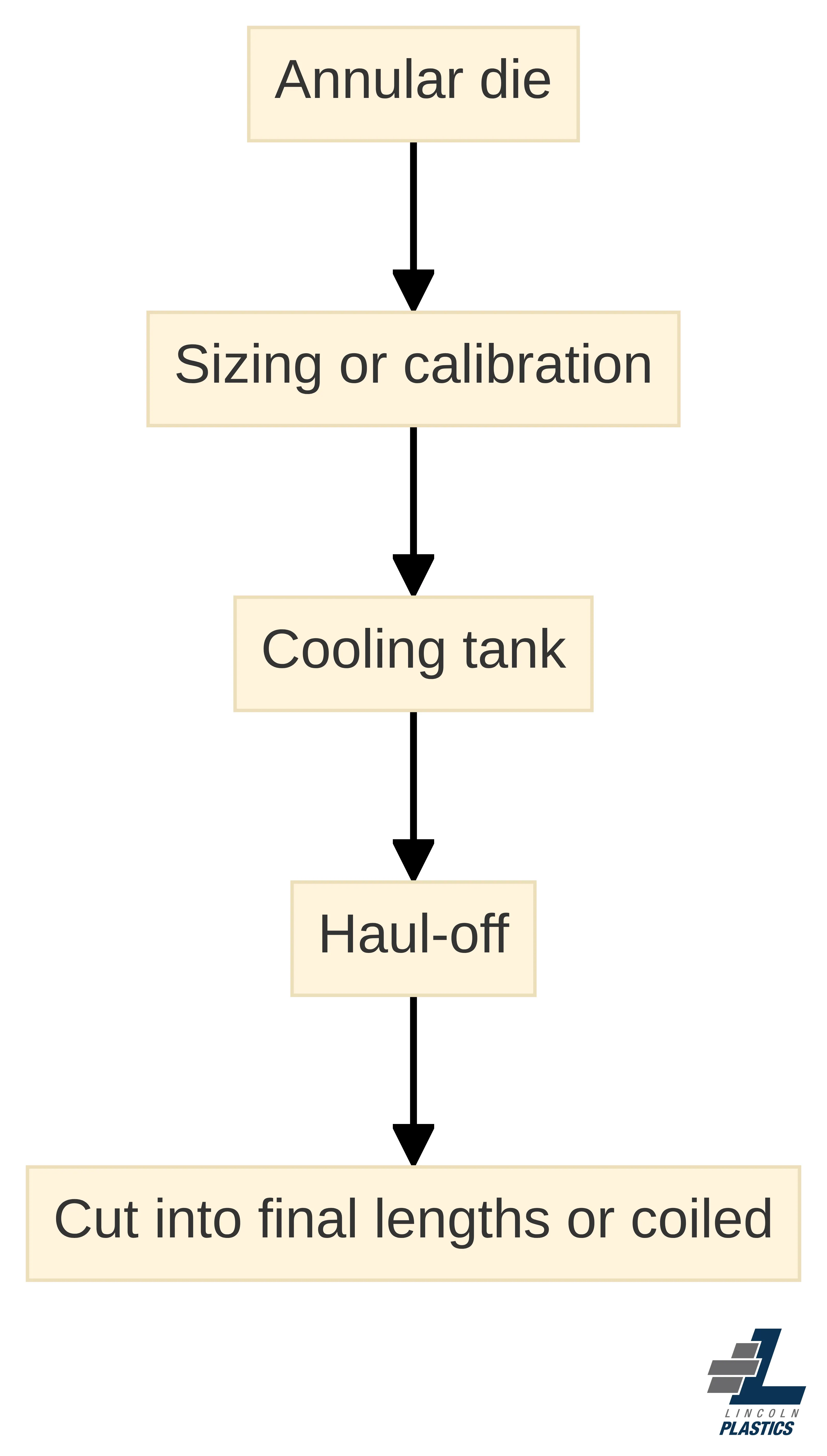
Pipe extrusion shapes the finished product through a sequence that begins with a tubular melt and continues through sizing, cooling, pulling, and finishing. A pipe extrusion line uses an annular die to form the continuous tubular melt, then sends the molten pipe through a sizing or calibration bench that adjusts its dimensions. The pipe then passes through a cooling tank and a haul-off before it is cut into final lengths or coiled.
Each stage gives you a different question for the RFQ. The die and forming stage relate to the requested profile. The sizing or calibration stage relates to how the line brings the developing pipe toward the specified dimensions. Cooling and haul-off affect how the product moves through the line before finishing. Cutting or coiling determines how the finished pipe will be supplied and handled.
Do not reduce this sequence to a promise that the finished pipe will meet every requirement automatically. The process description explains how pipe is made; it does not establish the correct dimensions, acceptable variation, material compatibility, outdoor performance, or application suitability for your project.
Ask the supplier to connect the process sequence to your requirement record:
- Which dimensions require review before tooling or production planning?
- Which dimensions are critical to assembly, flow, containment, clearance, or connection?
- How will the requested wall thickness and profile geometry be checked?
- Will the finished product be cut to defined lengths or supplied in coils?
- Which assumptions about handling, packaging, or downstream assembly affect the requested form?
- Which process or inspection records will accompany approval samples or production shipments?
The pipe line creates a path from melt to finished product. Your specification should create a parallel path from application need to measurable acceptance.
A pipe’s movement through sizing, cooling, haul-off, and finishing also explains why geometry and supply format belong in the same conversation. A requirement for a particular length, coil form, or connection cannot be separated from the way the product will be handled after it leaves the die. State the finished form early, then ask the supplier to identify any production or handling conditions that need resolution.
For a pipe-specific review, map each important requirement to the stage where it should be addressed and the evidence that will confirm it. The annular die and tooling discussion should address the requested cross-section. The sizing or calibration discussion should address how inside diameter, outside diameter, wall thickness, and any roundness requirement will be brought into the specification. The cooling and haul-off discussion should identify when and where the developing product will be measured, rather than leaving the measurement stage implicit. The finishing discussion should address cut ends, final lengths, coiling, and any handling condition that could affect the delivered form.
This map helps purchasing distinguish a process explanation from an acceptance answer. A supplier may describe how the line forms and moves the pipe, but the RFQ should still ask which dimensions are critical, how they will be measured, and which records will accompany approval. If a feature controls a connection or assembly, identify that relationship beside the dimension. If a feature is primarily descriptive, label it accordingly. The result is a review that follows the pipe from formation to release without treating any single machine stage as proof of application suitability.
Which extrusion process details should buyers treat as options rather than conclusions?
Pipe manufacturing uses both single-screw and twin-screw extruders. That process fact gives you a useful supplier question, but it does not select the right equipment for your product or prove that a proposed pipe meets its service requirements.
Treat the extrusion equipment, die approach, sizing method, cooling arrangement, haul-off, finishing method, and production sequence as items for technical review. They are part of the supplier’s manufacturing response, not substitutes for your application specification. A supplier should be able to explain how its proposed approach relates to the requested profile and what conditions remain subject to review.
Use questions that expose the boundary between a manufacturing option and a purchasing conclusion:
- Which parts of the proposed process are fixed by the requested geometry?
- Which parts are the supplier’s recommended approach rather than a customer requirement?
- What information is needed to review the die, tooling, or sizing approach?
- Which dimensions or features may affect process feasibility or inspection?
- What production quantity, lot structure, or delivery format must be known before the process is selected?
- What sample or first-article information will be available before production approval?
A process option becomes meaningful only when it is tied to a defined product and a stated acceptance method. Avoid choosing a supplier because it names a particular extruder type. Ask what the proposed process is intended to achieve, what evidence will demonstrate that result, and which application questions still belong with your engineering or technical team.
The practical purchasing boundary is clear: ask suppliers to recommend a manufacturing route, but do not turn the route into an application guarantee. The supplier can address extrusion and manufacturability; your organization must define the service decision and approval criteria.
What requirements define the pipe you actually need?
The pipe you need is defined by the job it performs, not by the product label alone. Build the requirement record around the finished assembly and make each field specific enough for a supplier to answer.
Application and function
Describe where the pipe will be used, what it will connect to, and what role it performs. State whether the pipe carries, contains, routes, protects, separates, or supports something. Include a drawing, assembly view, installation sketch, or photographs when those materials clarify interfaces. Mark dimensions and conditions that are essential to fit or function.
Geometry
Record the inside dimension, outside dimension, wall-thickness expectation, cross-sectional shape, straightness needs, bends, ends, openings, surface features, and any secondary operations. Identify which dimensions are critical and which are descriptive. A supplier cannot resolve a tolerance question if the RFQ does not identify the fit or function that the tolerance protects.
Supply form
State the required cut length, permissible length variation, coil requirement, packaging form, labeling, and shipment unit. If the product will be cut or assembled after delivery, explain the downstream operation. A length requirement is more useful when the supplier knows whether it controls installation, assembly timing, material yield, or handling.
Service conditions
Record the contents or contact material, pressure or non-pressure use, temperature range, outdoor exposure, sunlight, moisture, chemicals, abrasion, impact, flexing, installation loads, storage conditions, and expected duty pattern when those conditions apply. Use actual project requirements rather than broad phrases such as industrial use or outdoor use.
Material direction
State whether your organization has a specified resin, grade, color, additive package, or approved material list. If material direction is open, identify the resin supplier or technical party responsible for recommending candidates. Ask the extrusion supplier to comment on manufacturability and production considerations without turning manufacturing guidance into an unsupported material-performance guarantee.
Quality and approval
List the drawings, samples, dimensional records, material information, inspection results, certificates, change-notification expectations, and first-article or production-approval steps your organization requires. Separate evidence required for supplier qualification from evidence required to establish application performance.
A complete requirement record does not need to answer every technical question before you contact a supplier. It does need to show which questions are decided, which are open, and who will make each decision. That structure prevents a quote from appearing more complete than the underlying specification.
How should wall thickness and sizing be verified?
Wall thickness and sizing should be verified against the function of the pipe, the mating parts, and the acceptance method rather than copied from a generic nominal description. Start by identifying the dimensions that control your decision: inside diameter, outside diameter, wall thickness, length, roundness, end condition, and any feature that must pass through or connect to another component.
Specify each dimension with its unit, nominal value, allowable variation, measurement location, and importance. If wall thickness must be consistent around the circumference or along the length, say so as a requirement for supplier review and define how your organization will judge it. If a drawing already controls the geometry, attach the controlled revision and identify the dimensions that cannot change without approval.
Ask for a measurement plan that matches the product. The plan should make clear:
- Which dimensions will be measured.
- Where along the pipe each measurement will be taken.
- Whether measurements apply to a sample, each part, each lot, or another defined frequency.
- Which instruments or methods will be used.
- How the supplier will record results and handle an out-of-specification result.
- Which dimensions will be confirmed on approval samples before production release.
Do not specify a narrow tolerance merely because it looks precise. A tolerance should protect a real fit, clearance, connection, flow, assembly, or service requirement. If you do not yet know which tolerance is necessary, mark the dimension for engineering review instead of presenting an arbitrary number as final.
Ask the supplier to separate three answers: what dimensions the supplier can manufacture, what dimensions the proposed process is expected to hold under the stated conditions, and what measurements will demonstrate conformity. Those answers should appear beside the corresponding RFQ requirement.
For purchasing, the useful result is not a promise that the pipe is accurately sized in the abstract. The useful result is a documented relationship between your critical dimensions, the supplier’s proposed process, the measurement method, and the approval decision.
Treat the hollow cross-section as a related set of measurements rather than as independent numbers. Inside diameter can control a passage, clearance, or connection; outside diameter can control fit, support, or an interface with another part; and wall thickness sits between those requirements. A change or variation in one measurement can therefore affect how the others should be interpreted. When the pipe must remain substantially circular, roundness should be identified as its own requirement instead of being assumed from an inside- or outside-diameter value.
The RFQ should explain why each critical dimension matters. For example, identify whether the inside diameter protects a required opening, whether the outside diameter must enter or mate with another component, and whether wall thickness supports a stated handling, containment, or service requirement. Do not infer a pressure or structural conclusion from geometry alone. Those conclusions require the defined service conditions and the appropriate technical review.
Ask the supplier to show how the measurement plan represents the finished profile. Clarify whether measurements are taken at defined locations around the cross-section, along the length, or at a specified production stage. If the pipe is cut or coiled, identify whether the measurement record applies before finishing, after finishing, or to both forms when that distinction matters. The purpose is not to impose an unapproved test method; it is to make the acceptance question visible before the quote is treated as complete.
For purchasing, this approach also makes supplier comparisons fairer. One response may state a nominal diameter while another identifies the measurement locations, wall-thickness assessment, roundness requirement, and approval record. The second response is not automatically acceptable, but it makes the remaining technical decision easier to assign and verify.
Which service conditions must be defined before material review?
Service conditions should be defined before a material direction is treated as acceptable. Record the environment in which the pipe will operate, the loads or contact conditions it will experience, and the consequences if the pipe does not perform as required.
Start with the questions that change the technical review:
- Is the pipe used for pressure service, non-pressure service, or a function that still creates meaningful stresses?
- What will contact the inside, outside, or both surfaces?
- What temperatures apply during storage, installation, normal operation, cleaning, and foreseeable excursions?
- Will the pipe be exposed to sunlight, weather, moisture, chemicals, abrasion, impact, bending, vibration, or repeated movement?
- Will the pipe be buried, supported, clamped, routed, coiled, or connected to another material?
- How long must the pipe remain in service, and what maintenance or replacement assumptions apply?
- Which failure modes matter most to the equipment owner, operator, or end user?
Pressure service deserves its own field rather than an implied assumption. The PPI handbook states that PE piping standards specify minimum material requirements based on ASTM D3350 cell requirements. The handbook also describes a PE material designation code that identifies the maximum recommended hydrostatic design stress for water at 73°F (23°C). Those conditions belong with the material and service discussion; they should not be generalized into a performance conclusion for every pipe, fluid, temperature, pressure, or application.
If your application involves water pressure, identify the relevant design condition and the applicable technical requirements for your project. If your application is non-pressure, do not assume that pressure-related terminology is irrelevant; describe the loads, handling, installation, and operating stresses that still matter. Ask the supplier and the responsible technical professional to identify which material and design information is needed.
A material review is productive when it answers a defined service question. It is premature when the RFQ contains only a resin name, nominal size, or broad industry label.
For an agricultural irrigation request, separate the water-service question from the field-exposure question. Identify whether the pipe is part of a pressure path or serves a non-pressure routing or protection function. Then record the relevant water conditions, operating temperatures, connections, support or clamping arrangement, and any loads created during installation or use. Separately describe sunlight, moisture, weather, storage before installation, and the period for which the pipe will remain exposed. Calling a component part of a center pivot irrigation system does not supply these design conditions by itself.
This separation gives the supplier and the buyer different questions to answer. The pressure or non-pressure classification helps determine which service information must be reviewed. The outdoor description informs the weatherability discussion. The geometry and connection description identifies the dimensions that must be held for assembly. The quality section then identifies which records are needed to show that the defined dimensions and material direction were addressed. None of these records should be treated as a substitute for application validation.
When comparing responses for an irrigation component, look for explicit treatment of the water path, external environment, connection points, and approval responsibility. A response that addresses only the resin or nominal pipe size leaves the most important service questions open. A response that identifies those questions, states its assumptions, and distinguishes manufacturing review from application qualification gives the purchasing team a clearer basis for the next technical decision.
How should UV exposure and weatherability enter the specification?
UV exposure should enter the specification as part of the complete weathering environment, not as a decorative product attribute. For prolonged outdoor exposure, the material composition should be selected for the weather-resistance requirements of the specific conditions involved. Thermoplastics differ in their inherent resistance to weather deterioration, and selected additives can improve weatherability.
Translate outdoor use into a service description that a supplier can review. Include the expected exposure location, whether the pipe is continuously outdoors or protected for part of its life, sunlight intensity or exposure pattern when known, seasonal conditions, moisture, temperature changes, installation timing, storage before installation, and any covering or shielding. State whether the pipe will remain exposed after installation or spend only a limited period outdoors before being enclosed.
Ask for a response that distinguishes among:
- The weather-resistance requirement created by your application.
- The material or additive direction being proposed or reviewed.
- The evidence available to support that direction for the stated exposure.
- Any limits, assumptions, or validation steps that remain before approval.
Do not treat a color description as a complete UV specification. Do not treat the words outdoor grade or UV resistant as a substitute for the exposure conditions and acceptance evidence your project requires. The right question is not whether a pipe has an outdoor label; it is whether the proposed material composition and product definition address the actual weathering conditions.
For a center pivot irrigation component or another agricultural application, describe field exposure, storage, installation, and replacement conditions separately. The outdoor requirement should follow the product through its entire expected service path, including periods before the equipment is commissioned.
Why is a material label not enough to establish performance?
A material label is not enough to establish pipe performance because the service requirement includes more than the name of a polymer. Grade, formulation, geometry, wall thickness, exposure, temperature, pressure, contact conditions, processing, and acceptance criteria may all need to be considered together.
The PPI handbook gives a specific example of why material terminology needs context: its PE material designation code identifies maximum recommended hydrostatic design stress for water at 73°F (23°C). That statement has defined conditions. It should not be carried over to a different fluid, temperature, pressure condition, material, or application without the appropriate technical review.
Weathering provides another boundary. Thermoplastic polymers vary in inherent resistance to weather deterioration, and selected additives can improve weatherability. For prolonged outdoor exposure, material composition should be selected for the specific weather-resistance conditions involved. A generic polymer name therefore cannot, by itself, establish the weatherability of the finished pipe in your environment.
Use the material section of the RFQ to document responsibility and questions:
- Identify any customer-mandated material, grade, color, or approved-resin list.
- Identify whether a resin supplier or another technical party will recommend material candidates.
- Describe the pressure, temperature, contents, outdoor exposure, and mechanical conditions that the candidate must address.
- Ask the extrusion supplier to review manufacturability, profile requirements, tolerances, tooling, and production considerations.
- Request the material information and application evidence required for approval.
- Record what remains an engineering or validation decision rather than treating a supplier comment as final qualification.
This approach keeps material selection and extrusion manufacturing in their proper relationship. A supplier can help translate a defined application into a manufacturable pipe request, while the responsible technical team determines whether the proposed material and finished product are suitable for the intended service.
What should an extruded-pipe RFQ document?
An extruded-pipe RFQ should document the product, the service, the production request, and the evidence required for approval. The supplier should be able to identify the requested pipe, understand the conditions that shape the specification, and show which parts of the response are assumptions or recommendations.
Use this RFQ structure.
1. Project and application summary
Name the equipment, assembly, or product in which the pipe will be used. Describe the pipe’s function, installation environment, expected duty, and the consequence of a dimensional or service mismatch. State whether the request concerns a new design, replacement component, redesign, or source change.
2. Controlled technical information
Attach the current drawing, model, sketch, sample description, or dimensional record. Identify the revision, units, critical dimensions, mating parts, connection details, required surface condition, color, and any secondary operations. Mark what is fixed and what is open for supplier review.
3. Service conditions
State pressure or non-pressure use, contents or contact materials, operating and storage temperatures, outdoor or indoor exposure, UV and weather conditions, moisture, chemicals, abrasion, impact, flexing, vibration, support, clamping, and installation method when applicable. Replace general labels with project conditions wherever possible.
4. Material direction
State the material, grade, formulation, additive, color, or approved-material requirement if your organization has already defined it. If the material is open, say so and identify the resin supplier or technical authority responsible for recommendations. Ask for manufacturability comments separately from application-performance conclusions.
5. Geometry and supply form
List inside and outside dimensions, wall thickness, tolerances, straight lengths or coils, cut-length requirements, end conditions, packaging, labeling, and shipment units. Identify the dimensions that control fit, flow, clearance, connection, containment, or assembly.
6. Quantity and production context
State prototype, pilot, qualification, launch, and expected production quantities separately when those stages differ. Include forecast information, target lot size, required shipment form, and any change-control expectations. Do not ask a supplier to price an annual quantity without explaining how that quantity relates to releases or approval stages.
7. Quality and acceptance
List the inspection records, samples, material information, certificates, dimensional reports, first-article requirements, approval gates, packaging requirements, traceability expectations, and nonconformance process your organization uses. Identify which evidence is needed with the quote, with samples, and with production shipments.
8. Supplier response format
Ask the supplier to return a clear statement of assumptions, exclusions, open questions, proposed process, tooling considerations, sample plan, production conditions, lead-time assumptions if relevant to your purchasing process, and price structure. Ask the supplier to identify any requirement that cannot be confirmed from the information supplied.
A strong RFQ does not force the supplier to guess. It gives the supplier room to explain the proposed manufacturing route while preserving your control over the application, acceptance criteria, and approval decision.
Which supplier questions expose remaining technical risk?
Supplier questions should expose the gap between a manufacturable concept and an approved product. Ask for specific answers tied to the drawing, service conditions, and acceptance plan rather than broad assurances.
Questions about the product definition
- Which dimensions, features, or service conditions remain unclear?
- Which requirements are treated as critical in the quotation, and what makes them critical?
- What drawing, sample, model, or additional information is needed before technical review can be completed?
- Which assumptions did you make about the pipe’s use, installation, contents, or delivery form?
Questions about extrusion and tooling
- How does the proposed extrusion route address the requested tubular profile?
- What tooling or sizing review is required before a production quotation can be finalized?
- Which features may affect manufacturability, inspection, cutting, coiling, or packaging?
- What changes to geometry would make the request easier to review without weakening the application requirement?
Questions about materials and service
- Which material information is needed to evaluate the stated pressure, temperature, contents, outdoor exposure, and mechanical conditions?
- Is the material direction customer-specified, recommended by a resin supplier, or still open?
- Which weather-resistance assumptions apply to the stated outdoor exposure?
- What application validation remains the responsibility of the purchasing organization or its technical professional?
Questions about dimensions and inspection
- How will inside diameter, outside diameter, wall thickness, length, and other critical features be measured?
- Where will measurements be taken, and at what stage of production?
- What sample size, inspection frequency, records, and disposition process apply?
- How will the supplier handle a result outside the agreed requirement?
Questions about production readiness
- What is required to move from prototype or approval samples to production?
- Which process, tooling, material, packaging, or inspection changes require approval?
- What documentation accompanies a production shipment?
- How are revisions, substitutions, deviations, and nonconformances communicated?
Questions about the quote itself
- Which costs are included, and which tooling, sampling, testing, packaging, or setup costs are separate?
- Which quantities, release patterns, and delivery assumptions support the quoted structure?
- Which conditions could change the response after drawing, material, or service review?
The supplier’s answer should make risk easier to assign. If the response says a requirement is possible but does not identify the proposed process, measurement method, assumption, or approval evidence, keep the item open.
How should supplier responses be compared?
Supplier responses should be compared against the same requirement record, not against the most attractive price or the longest capability list. Create a response record with one line for every requirement that affects the sourcing decision.
Use these comparison fields:
- Requirement: What the pipe must do, measure, withstand, contain, connect to, or provide.
- Supplier response: The exact proposed product, process, material direction, supply form, and commercial assumption.
- Evidence: Drawing, sample, measurement report, material information, quality record, or other document that supports the response.
- Status: Confirmed, proposed, open, conditional, or not addressed.
- Owner: Purchasing, engineering, quality, operations, resin supplier, or another responsible party.
- Decision date or gate: The point at which the item must be resolved before approval.
- Consequence: The purchasing or application consequence if the item remains open.
Keep manufacturing and application questions separate. A supplier may provide a clear response about extrusion, tooling, sizing, cutting, coiling, or inspection while the application team still needs to establish material compatibility or service suitability. That is not a contradiction; it is a reason to assign the two decisions separately.
Compare the following areas in the same order for every supplier:
- Understanding of the application and service conditions.
- Response to critical dimensions, wall thickness, tolerances, and supply form.
- Material responsibility and clarity about open technical decisions.
- Proposed extrusion and tooling review.
- Inspection method and quality evidence.
- Prototype, sample, qualification, and production transition.
- Assumptions affecting quantity, packaging, change control, and commercial terms.
- Ability to identify what the response does not yet establish.
A response with more detail is not automatically stronger. Look for traceability between each requirement and the proposed answer. Give attention to conditional language, unresolved dimensions, undefined service conditions, missing evidence, and assumptions that shift risk back to your organization.
The purchasing decision should state why a supplier advances, what remains open, and what must happen before approval. That record is more useful than a simple ranking because it preserves the reasoning behind the decision when the design, volume, or supplier response changes.
What can Lincoln Plastics review for a custom pipe request?
Lincoln Plastics provides custom plastic extrusion tubing for OEMs, including applications in irrigation and cord covers. We provide tailored OEM solutions including pipes, tubes, and flexible profiles.
A pipe request is easier for Lincoln Plastics to review when the RFQ includes the application description, controlled geometry, wall-thickness expectations, service conditions, material direction, supply form, quantity context, and approval requirements described in this guide. Those details give our team a defined manufacturing question instead of a product label with missing conditions.
Use the request to separate what you need from what you want us to assess. You define the application, operating conditions, critical dimensions, and acceptance decision. Lincoln Plastics can then review the requested extrusion product and identify the manufacturing information, drawing details, tooling questions, or production considerations that need attention before the request advances.
Include these items in the message:
- The pipe’s role in the OEM equipment or agricultural application.
- Inside diameter, outside diameter, wall thickness, lengths, tolerances, and any connection or assembly features.
- Pressure or non-pressure use, contents or contact conditions, temperature, outdoor exposure, UV requirements, and other service conditions.
- Material or grade requirements, including whether the material direction is already specified or still subject to resin-supplier recommendation.
- Estimated quantities, prototype or production stage, requested supply form, and packaging needs.
- Drawings, photographs, samples, or models that make the request easier to interpret.
- The quality records, samples, measurements, and approval steps required before release.
The purpose of the request is not to ask Lincoln Plastics to assume application responsibility from a short description. The purpose is to give us enough information to discuss a custom pipe or tube extrusion request in the context of your actual equipment and purchasing decision.
Lincoln Plastics helps OEMs fine-tune designs for manufacturing while maintaining quality standards. Use that discussion to identify manufacturability questions without changing a critical application requirement casually. If a geometry change is proposed, record the reason, the affected dimension or feature, the responsible technical approver, and the evidence needed before the change becomes part of the released specification.
What quality evidence should be requested before approval?
Quality evidence should show how the quoted pipe will be identified, measured, reviewed, and approved against your requirements. Ask for evidence that matches the risk of the application rather than collecting general documents that do not address critical dimensions or service conditions.
Lincoln Plastics is certified to the ISO 9001 standard. That certification is a supplier quality fact, but it is not a substitute for the product-specific evidence your approval process requires. Keep the certification statement separate from dimensional conformity, material information, application validation, and production-release records.
Build the quality request around four stages.
Before quotation or technical review
Ask for confirmation that the supplier has the current drawing, application description, service conditions, material direction, and supply-form requirements. Ask the supplier to identify information that remains necessary for a meaningful response.
Before sample approval
Define the dimensions, wall-thickness locations, lengths, surface features, ends, connections, and other characteristics that must be checked. State the measurement method, sample quantity, reporting format, and disposition process for results that do not meet the requirement.
Before production release
Identify the approval package required by your organization. It may include an approved drawing, sample record, material information, dimensional report, agreed inspection plan, packaging specification, change-control expectations, and records for unresolved technical conditions. Use only the documents that your project actually needs.
During production supply
State which records accompany shipments, how lots or releases are identified, how nonconformances are communicated, and which changes require approval. Make the supplier response specific to your requirement rather than accepting a general statement that quality is controlled.
Ask one question beside every critical requirement: what record will show that this requirement was addressed? If the answer is a supplier statement, ask whether a measurement, sample, report, drawing, or application check is also required. Quality evidence is useful when it connects a requirement to a decision.
A practical acceptance plan can divide evidence into three related layers. Dimensional evidence addresses the released geometry: inside and outside dimensions, wall thickness, length, ends, connections, and any roundness or surface requirement. Material and process evidence addresses the defined material direction, relevant production information, inspection method, and the supplier’s stated assumptions. Service evidence addresses the application questions that cannot be settled by a dimensional report alone, such as pressure, temperature, contents, outdoor exposure, or other operating conditions. The exact documents should follow the project’s requirements, but the layers help prevent one type of record from being mistaken for another.
Use the same structure when reviewing samples. First ask whether the sample represents the requested profile and supply form. Then check whether the agreed measurements were taken and recorded. Finally identify which service or application questions remain open even if the sample matches the drawing. This keeps a visually acceptable sample from being treated as complete validation when material, exposure, or operating conditions still require review.
The acceptance record should also show decision ownership. Purchasing can confirm that the required documents are present, quality can review the agreed inspection records, and the responsible technical team can determine whether the material and finished product address the intended service. Recording those boundaries makes the approval gate more useful than a general statement that the supplier has a quality system.
What can an early RFQ response not establish?
An early RFQ response cannot establish application suitability when the service conditions, material direction, geometry, or acceptance method remain undefined. A supplier may be able to comment on a custom extrusion concept while important technical decisions still belong to your engineering, quality, resin-supplier, or other qualified technical team.
Do not treat the following as established merely because they appear in a quote:
- Suitability for a particular fluid, chemical, pressure, temperature, or duty cycle.
- UV or weathering performance for a defined outdoor exposure.
- Acceptable wall thickness or dimensional variation without an agreed measurement and acceptance method.
- Compliance with a customer, industry, regulatory, or project requirement that the RFQ did not identify.
- Finished-product performance based only on a material name, nominal size, or supplier capability statement.
- Application approval based only on a prototype, quotation, or general quality certification.
An early response can identify questions, propose a manufacturing route, clarify tooling or geometry issues, and show what information the supplier needs next. It can also reveal whether the supplier understands the application and can organize a response around your requirements.
Before approval, assign each unresolved item to the person or organization qualified to decide it. A qualified engineering or technical professional should determine individual application suitability and the validation needed for release. Purchasing can preserve that boundary by recording open conditions instead of converting a preliminary response into a performance promise.
Key Highlights
Extruded pipe sourcing becomes clearer when you keep the manufacturing route and the application proof separate.
- An extruder converts raw plastic into a continuous tubular melt through an annular die. Sizing, cooling, haul-off, and cutting or coiling complete the basic pipe-extrusion sequence.
- Single-screw and twin-screw extruders are both used for pipe manufacturing, but equipment type alone does not decide whether a product fits your application.
- Wall thickness, inside diameter, outside diameter, length, tolerances, supply form, and measurement method should be explicit in the RFQ.
- Pressure, temperature, contents, outdoor exposure, UV conditions, installation, and mechanical service conditions must be defined before material review becomes meaningful.
- For prolonged outdoor exposure, material composition should address the specific weather-resistance conditions involved; thermoplastics differ in inherent weather resistance, and selected additives can improve weatherability.
- A PE material designation code has defined conditions, including maximum recommended hydrostatic design stress for water at 73°F (23°C). Do not generalize that information to another service without technical review.
- Lincoln Plastics provides custom plastic extrusion tubing for OEMs, including irrigation and cord-cover applications, as well as tailored pipe, tube, and flexible-profile solutions.
- Lincoln Plastics is certified to the ISO 9001 standard, while your project still needs product-specific dimensions, inspection records, material information, and approval evidence.
- A complete RFQ states what is decided, what remains open, what the supplier must answer, and what evidence your organization requires before release.
Submit a requirement-led RFQ for technical review
Use a pipe-specific acceptance review to separate service and validation questions: state whether the application is pressure or non-pressure, describe water conditions and connections, identify wall-thickness and sizing checks, note UV exposure, and name the evidence required before approval. Gather the drawing or dimensional information, identify the critical wall and sizing requirements, describe outdoor or operating exposure, state the material responsibility, and list the questions that must be answered before production approval.
A qualified engineering or technical professional should determine individual application suitability and the validation required for release. Keep that decision distinct from the supplier’s review of extrusion, tooling, manufacturability, inspection, and production considerations.


